Xuanhanosaurus
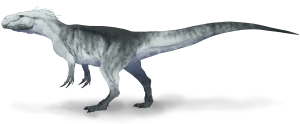
Xuanhanosaurus is a genus of non-avian theropod dinosaur whose name translates as “Xuanhan lizard”, in reference to Xuanhan County in China’s Sichuan Basin where its remains were first uncovered. The animal lived during the Middle Jurassic Bathonian stage, approximately 166 million years ago, and represents one of several non-coelurosaurian tetanuran dinosaurs known from the Lower Shaximiao Formation. Despite its early discovery, it has been relatively understudied, though most researchers recognise it as a tetanuran, possibly close to the base of Allosauroidea.
Discovery and Geological Context
The only known species, Xuanhanosaurus qilixiaensis, was named in 1984 by the Chinese palaeontologist Dong Zhiming. The specific epithet refers to the town of Qilixia near the discovery site. The holotype specimen, IVPP V6729, was recovered in 1979 during a regional dinosaur fossil survey in Sichuan Province. Guided by local field teams, the survey reached the Qilixia section where the fossil was located on the southern flank of the Qili Dorsal Slope.
The remains were found within the Lower Shaximiao Formation, a Middle Jurassic geological unit that has produced several theropods, sauropods and ornithischians. The holotype consists of a partial postcranial skeleton without the skull, including a scapula lacking its posterior end, a coracoid, a probable sternum, humerus, radius, ulna and manus, along with portions of several dorsal vertebrae.
The region’s palaeoenvironment during the Bathonian is interpreted as a warm, seasonally variable floodplain system with extensive vegetation and river channels, enabling a diverse dinosaur fauna to thrive.
Anatomical Characteristics
Early estimates proposed a body length of around 6 metres, but more recent assessments place Xuanhanosaurus at approximately 4.8 metres (16 feet) long and about 265 kilograms in mass. Its anatomy combines primitive and derived traits, making it important for understanding early tetanuran evolution.
One of its most notable features is the retention of a reduced, vestigial fourth metacarpal in the hand. Together with its robust forelimbs—measuring over 65 cm long—this trait originally led Dong to suggest that Xuanhanosaurus may have been capable of quadrupedal locomotion. If correct, it would have been unique among known carnivorous dinosaurs. However, subsequent research indicates that forearm pronation, which is required for quadrupedal stance, was impossible in theropods. The strong arms are instead interpreted as adaptations for grasping or restraining prey, consistent with bipedal locomotion.
Further anatomical observations include:
- A convex proximal surface on distal carpal 2, which may represent a transitional stage in the evolution of the semilunate carpal later seen in maniraptorans.
- Retention of short, ceratosaurian-like phalanx II-1, similar to examples observed in Saltriovenator, suggesting a mosaic of primitive features.
- A scapula that is noticeably bulkier than that of Allosaurus.
- A humerus with a laterally enlarged distal end forming a distinctive step-like projection.
- Vertebrae that are posteriorly concave and anteriorly projecting, with cervical centra bearing flat anterior surfaces—a condition also recorded in Condorraptor, Piatnitzkysaurus and Szechuanosaurus zigongensis. Unlike some of these taxa, however, the vertebrae of Xuanhanosaurus do not show posterior pneumatic foramina or fossae.
These anatomical details mark the taxon as a morphologically significant dinosaur for examining early tetanuran structural diversity, particularly in forelimb evolution.
Phylogenetic Interpretations
Since its original description, the phylogenetic placement of Xuanhanosaurus has been the subject of continued revision. Dong initially classified it within Megalosauridae, at the time an expansive and broadly defined family. He argued that its vestigial metacarpal IV placed it at an intermediate stage in tetanuran evolution.
In 2009, the taxon was considered by some researchers to occupy a primitive position within Megalosauroidea. A subsequent study in 2010 revised this interpretation, instead placing Xuanhanosaurus as the most basal member of Metriacanthosauridae, a family of Middle Jurassic to Early Cretaceous allosauroids known for their moderately built bodies and distinctive vertebral morphology.
Later work in 2018 suggested that Xuanhanosaurus, along with Szechuanosaurus zigongensis, might represent an early-diverging ceratosaurian–tetanuran lineage, based on features such as the proportions and evolutionary persistence of metacarpal IV. In 2019, a detailed phylogenetic assessment by Rauhut and Pol recovered Xuanhanosaurus as the basalmost member of Allosauroidea, placing it outside Metriacanthosauridae but close to the origins of the allosauroid clade.
These varying interpretations highlight the incomplete nature of the fossil material but also underscore the taxon’s importance for reconstructing the morphological transitions occurring within Middle Jurassic theropods.
Palaeobiological Significance
Xuanhanosaurus contributes valuable insights into the evolutionary experimentation taking place among early tetanurans. Its combination of strong forelimbs, retained primitive manual elements and developing wrist adaptations offers clues to shifting predatory strategies and locomotor mechanics within the group.
| Related | |
|---|---|