Lake Baringo
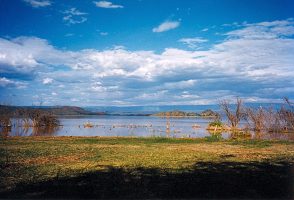
Lake Baringo is one of the northernmost lakes in Kenya’s segment of the East African Rift Valley, second only to Lake Turkana in latitude. Known for its ecological diversity, geological significance and cultural landscape, it is one of only two freshwater lakes in Kenya’s Rift Valley—the other being Lake Naivasha. The lake is situated in a hot, semi-arid region and has long been recognised for its abundant birdlife, unique wildlife communities and dynamic hydrological behaviour. Over time, it has also become an important centre for fisheries, tourism and regional livelihoods.
Physical Setting and Hydrology
Lake Baringo sits within the central sector of the East African Rift and is bordered by significant geological features. To the west are the Tugen Hills, an uplifted block composed largely of volcanic and metamorphic rocks; to the east rises the Laikipia Escarpment. The lake receives inflow from several rivers—most notably the Molo, Perkerra and Ol Arabel rivers—which drain the Mau and Tugen hillslopes.
The lake has no surface outlet. It is generally assumed that water seepage occurs through lake sediments into the underlying volcanic bedrock. Baringo is also characterised by considerable turbidity, largely caused by sediment-laden inflows from eroded catchments, particularly the Loboi Plain to the south. Periodic droughts and significant irrigation withdrawals have historically contributed to reduced water levels, though recent years have seen dramatic expansion of the lake’s surface area.
Historical Discovery and Observation
European awareness of Lake Baringo dates to the mid-nineteenth century. Reports by Ludwig Krapf and Johann Rebmann in the 1850s first directed attention to the lake, although early maps were prone to confusion—J. H. Speke’s 1863 rendering misidentified Baringo in relation to Lake Victoria. Henry Morton Stanley’s 1877 map depicted it as a considerably larger water body. The Scottish explorer Joseph Thomson reached the lake in 1883 and provided more reliable details, correcting inflated estimates of its size. Local traditions long held that the lake formerly occupied a larger area, a view consistent with the lake’s fluctuating hydrology.
Ecology and Biodiversity
Lake Baringo is renowned as a critical habitat supporting more than 500 species of birds, making it one of East Africa’s prominent ornithological destinations. Seasonal visitors such as flamingos occasionally appear, adding to its ecological appeal. A notable feature is a Goliath heronry located on Gibraltar, a rocky islet within the lake.
The lake contains seven species of freshwater fish. One is the Nile tilapia subspecies Oreochromis niloticus baringoensis, endemic to the lake and of local economic importance. In recent decades, however, declining tilapia stocks have coincided with the success of the marbled lungfish Protopterus aethiopicus, which was introduced in 1974 and now forms the bulk of the fish catch. Monitoring of fish health has revealed relatively high parasite loads in endemic tilapia, prompting calls for public awareness regarding the consumption of undercooked fish.
The broader ecosystem includes hippopotamuses, Nile crocodiles, diverse amphibians and reptiles, and a range of invertebrate groups. On the Laikipia Escarpment, the greater kudu—a species rarely found elsewhere in East Africa—is known to inhabit the slopes and appears periodically near Baringo.
Termite mounds are a notable landscape feature around the lake, often forming hollow towers up to 3.6 metres high. These structures serve as a distinctive marker of the region’s ecological processes.
Geological Features and Islands
The lake contains several islands, the largest being Ol Kokwe Island—an extinct volcanic centre associated with the nearby Korosi volcano. The island hosts fumaroles and hot springs, some with visible sulphur deposition. Additional hot springs occur at Soro on the island’s northeastern shore.
The lake’s surroundings are notable for their rich geological and palaeontological record. The Tugen Hills contain Miocene to Pleistocene sedimentary sequences that have yielded significant fossil finds, including hominoid and hominin remains. These discoveries have contributed to broader studies of human evolution and the geological history of the Rift Valley.
Human Settlement, Livelihoods and Tourism
The town of Marigat is the principal settlement near Lake Baringo, with Kampi ya Samaki and Loruk serving as smaller lakeside communities. The wider region is inhabited predominantly by pastoralist groups, including the Il Chamus, Rendille, Turkana and Kalenjin peoples. Fishing, livestock rearing and small-scale agriculture are central to livelihoods.
Tourism has grown steadily, supported by accommodation facilities such as lodges, cottages and campsites around Kampi ya Samaki and on several of the islands. Boating excursions, birdwatching tours and visits to hot springs offer additional attractions for visitors.
Environmental Change and Recent Expansion
In the decade from 2010 to 2020, Lake Baringo underwent substantial expansion, with its surface area reported to have more than doubled to approximately 268 square kilometres. This rapid growth led to widespread flooding of lakeside villages, displacement of residents and increased encounters between humans and wildlife, especially crocodiles. While the exact causes of the expansion remain under study, contributing factors may include increased regional rainfall, land-use change and tectonic influences on groundwater flow.
Regional Context
Lake Baringo forms part of a chain of Rift Valley lakes stretching through Kenya. Its position makes it an important ecological and cultural landmark linking volcanic landscapes, palaeontological sites and traditional pastoralist territories. Nearby features include associated volcanic centres and Rift escarpments, as well as other lakes such as Nakuru to the south.