Vijayanagara Empire: Polity, Economy, Society and Administration
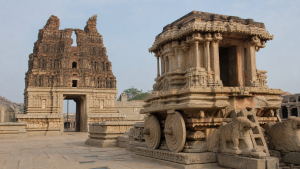
The Vijayanagara Empire was one of the most powerful states of medieval South India, ruling from Hampi on the Tungabhadra. It is remembered for a strong monarchy, efficient provincial administration, the Amara-Nayaka system, and a vibrant economy linked to agriculture, trade, and temple-centered urban life.
Dynastic Succession and Central Administration
- Four dynasties: Sangama (1336–1485 CE), Saluva (1485–1505 CE), Tuluva (1505–1570 CE), and Aravidu (1570–1646 CE) ruled the empire in succession.
- Absolute monarchy: The ruler, styled as Raya, exercised supreme executive, judicial, and military powers.
- Assistance to the king: The central administration was supported by a prime minister (Pradhani) and a council of ministers (Sabha).
- Administrative units: The empire was divided into Rajyas (provinces), which were governed by royal princes or trusted nobles.
- Further subdivisions: Provinces were split into Nadus (districts) and Sthalam (sub-districts).
- Village administration: The Ayagar system comprised twelve hereditary functionaries responsible for local administration.
- Village officials: Important among them were the village headman (maniyam) and accountant (karnam), who often received tax-free land grants called manyams.
The Amara-Nayaka and Revenue Systems
- Amara-Nayaka system: A key feature of Vijayanagara polity and military organization, under which land territories (amaram) were assigned to military commanders (nayakas) instead of cash salaries.
- Military obligations: The nayakas collected revenue from their assigned territories, maintained troops of infantry, cavalry, and elephants, and rendered annual tribute to the central authority.
- Primary revenue source: Land revenue, called sist or kadamai, was the main source of state income.
- Land classification: Revenue assessment depended on survey and classification of land into wet (nanjai), dry (punjai), and garden (totta) categories.
- Revenue supervision: The central government had a specialized revenue and audit department called Athavana.
- Other levies: The department kept records relating to customs duties, transit taxes, professional fees, and military expenditure.
Trade, Economy, and Currency
- Agrarian base: Agriculture formed the backbone of the economy, supported by irrigation works such as dams across the Tungabhadra, stone aqueducts, and tanks like the Kamalapuram tank.
- Indian Ocean trade: The empire traded actively through western ports such as Bhatkal and Mangalore.
- Exports: Major exports included textiles, rice, iron, saltpetre, and spices.
- Imports: Important imports included Chinese silk, porcelain, and military horses from Arabia and Persia.
- Commercial importance: Control over ports and long-distance trade strengthened the empire’s revenue and strategic position.
| Coin Name | Metal | Key Features |
| Varaha / Pagoda | Gold | Standard currency; often carried the image of Venkatesvara or the double-headed eagle (Gandaberunda). |
| Pratap / Gadyana | Gold | Worth half a Varaha; used in commercial transactions and tax payments. |
| Tara | Silver | Low-value fractional currency used in coastal trade and regional markets. |
| Jital / Pana | Copper | Basic daily transaction coin; a fraction of a silver Tara. |
Social Hierarchy and Cultural Synthesis
- Caste structure: Vijayanagara society remained hierarchical, with Brahmins occupying prominent administrative, diplomatic, and judicial positions.
- Merchant groups: Wealthy merchant guilds such as the Vira-Panchalas also enjoyed influence.
- Women in public life: Women served as state accountants, merchants, palace guards, wrestlers, musicians, court poets, and astrologers.
- Religious policy: The state patronized Shaivite, Vaishnavite, and Jain institutions and also employed Muslim archers, horsemen, and commanders in the army.
- Literary growth: The period saw a major literary revival in multiple languages.
- Notable works: Krishnadevaraya’s Telugu work Amuktamalyada and Gangadevi’s Sanskrit poem Madura Vijayam are important examples.
Art, Architecture and Foreign Accounts
- Imperial emblem: The Varaha (boar), associated with the third incarnation of Vishnu, served as the main state emblem.
- Temple architecture: Vijayanagara architecture followed the Dravida style, especially visible in large Gopurams and temple complexes.
- Distinctive features: Monolithic sculptures, carved pillars depicting the mythical Yali, and open pillared halls such as Kalyana Mandapa were prominent.
- Foreign travellers: Important external accounts came from Nicolo de Conti, Abdur Razzaq, Afanasy Nikitin, Duarte Barbosa, and Domingo Paes.
Key Prelims Takeaways
- Dynastic sequence: Sangama → Saluva → Tuluva → Aravidu.
- Political nature: The empire was an absolute monarchy headed by the Raya.
- Important administrative terms: Rajya, Nadu, Sthalam, Ayagar, Amaram, and Athavana.
- Revenue basis: Land revenue, especially sist or kadamai, was the main state income.
- Military-revenue link: The Amara-Nayaka system combined territorial control with military service.
- Economy: Irrigated agriculture, western port trade, and horse imports were crucial to state strength.
- Culture: Vijayanagara is known for temple architecture, multilingual literary output, and religious tolerance.
Current General Studies comprises current-affairs-based, General Studies-rich study material on policies, laws, institutions, economy, science, environment, governance, international relations, and other varied but important topics for UPSC and State PSC Prelims examinations.
Fortnightly PDF compilations: Available here
Originally written on
April 15, 2026
and last modified on
September 5, 2026.
| Related | |
|---|---|