Western House Martin
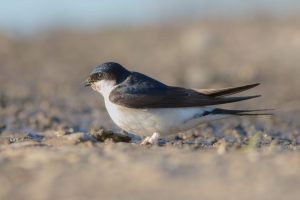
The western house martin (Delichon urbicum), also known as the common house martin or northern house martin, is a small migratory passerine bird belonging to the swallow family Hirundinidae. It is a familiar and widespread species across much of Europe, North Africa, and the temperate Palearctic, where it breeds, and it winters primarily in sub-Saharan Africa and parts of tropical Asia. Strongly associated with human settlements, the species is notable for its use of buildings as nesting sites, its agile aerial feeding behaviour, and its conspicuous white rump visible in flight.
Taxonomy and Nomenclature
The western house martin was first formally described by Carl Linnaeus in 1758 in the 10th edition of Systema Naturae, where it was placed in the genus Hirundo under the name Hirundo urbica. In 1854, the species was reassigned to its current genus Delichon by Thomas Horsfield and Frederic Moore, reflecting improved understanding of relationships within the swallow family.
The genus name Delichon is an anagram of the Ancient Greek word chelidōn, meaning “swallow”. The specific epithet urbicum (earlier rendered as urbica until 2004 due to a grammatical misunderstanding) is derived from Latin and means “of the town”, referring to the species’ close association with human habitation. Both the scientific and common names thus emphasise its urban nesting habits.
The genus Delichon represents a relatively recent evolutionary divergence from the barn swallow genus Hirundo. Three species are currently recognised within the genus. The western house martin was formerly considered conspecific with the Asian house martin (Delichon dasypus) and the Siberian house martin (Delichon lagopodum). The latter was split as a separate species on the basis of consistent morphological and vocal differences. Other proposed subspecies, such as meridionalis from the Mediterranean region, are now generally regarded as clinal variants rather than valid taxonomic units.
Two subspecies of the western house martin are currently accepted.
Physical Description
The adult western house martin is a compact, streamlined bird measuring approximately 13 cm in length, with a wingspan of around 26–29 cm and an average weight of 18–20 g. The upperparts, including the head and mantle, are a glossy steel-blue, contrasting sharply with the pure white rump and white underparts. The underwings are also white, a feature that is conspicuous in flight.
The eyes are brown, and the bill is short and black, adapted for catching insects on the wing. The legs are short, with toes and exposed parts of the legs pink, while the tarsi are covered in white downy feathers. The sexes are alike in appearance.
Juvenile birds differ from adults in having duller, sooty-black upperparts, with pale fringes to the wing coverts and flight feathers, giving a scaly appearance. These features wear off as the bird matures.
The subspecies Delichon urbicum lagopodum differs slightly from the nominate form in having a more extensive white rump that extends further onto the tail and a tail fork of intermediate depth between that of the western house martin and the Asian house martin.
Identification and Similar Species
The western house martin is most readily identified by its white rump and underparts, which distinguish it from other widespread Palearctic swallows such as the barn swallow (Hirundo rustica), sand martin (Riparia riparia), and red-rumped swallow (Cecropis daurica). In Africa, it may be confused with the grey-rumped swallow (Pseudhirundo griseopyga), but that species has off-white underparts and a much longer, deeply forked tail.
In flight, the western house martin has a rapid wingbeat, averaging about 53 beats per second, faster than that of the barn swallow, though its overall flight speed is typical of hirundines.
Distribution and Habitat
The breeding range of the western house martin extends across temperate Europe, North Africa (including Morocco, Tunisia, and northern Algeria), and eastwards across the Palearctic to central Mongolia and the Yenisei River. It migrates on a broad front to wintering grounds in sub-Saharan Africa, crossing both the Mediterranean Sea and the Sahara Desert.
The species favours open habitats with low vegetation, such as farmland, meadows, and pasture, particularly where water is nearby to provide mud for nest construction. Although originally a cliff and cave nester, it is now strongly associated with human settlements and will breed even in city centres, provided air quality is adequate. Compared with the barn swallow, it shows a greater tendency to nest in urban environments.
On the wintering grounds, the western house martin occupies similar open habitats but is generally less conspicuous, often flying higher and adopting a more nomadic lifestyle. In tropical regions such as East Africa, it is more commonly found at higher elevations.
Migration and Movement
The western house martin is a long-distance migrant, travelling thousands of kilometres between breeding and wintering areas. Migration occurs mainly during daylight, with birds feeding on aerial insects en route. Unlike large soaring birds, house martins are not funnelled through narrow migration corridors but move across broad fronts.
Migration exposes the species to significant risks. In 1974, several hundred thousand western house martins were found dead or dying in the Swiss Alps following severe snowfall and low temperatures. Studies indicate that adult survival during autumn migration is strongly influenced by temperature, while cold conditions during the breeding season are particularly detrimental to juvenile survival. Increasing frequency of extreme weather events linked to climate change is expected to have a growing impact on future survival rates.
Vagrants have been recorded far outside the normal range, including Alaska, Newfoundland, Bermuda, the Azores, and even Colombia. There are also records of migrants remaining to breed in Namibia and South Africa rather than returning north.
Behaviour and Feeding Ecology
The western house martin feeds almost exclusively on flying insects, including flies, aphids, beetles, and ants, which it captures in agile, sustained flight. It often forages at higher altitudes than other swallows, particularly in warm conditions, but may fly low over water during poor weather when insects are concentrated near the surface.
It is a vocal species, especially at breeding colonies. The male’s song is a soft, twittering series of melodious chirps given throughout the year. The contact call is a harder “chirrrp”, and the alarm call is a sharp, high-pitched “tseep”.
Predation is relatively limited, but the species is occasionally hunted by the Eurasian hobby (Falco subbuteo). Like most birds, it is also affected by internal parasites and external fleas and mites.
Breeding Biology
Breeding birds return to Europe between April and May, with nest construction beginning earlier in North Africa and later at higher latitudes. The western house martin typically breeds colonially, with small colonies of fewer than ten nests being common, although exceptionally large colonies numbering thousands of nests have been recorded.
The nest is a neat, closed cup made from mud pellets and fixed beneath an overhang, such as house eaves or bridge ledges. Both sexes participate in construction, collecting mud from ponds, streams, or puddles. The nest is lined with grasses, feathers, and hair, and has a narrow entrance at the top. This design helps prevent occupation by house sparrows, which frequently attempt to take over nests during construction.
A typical clutch consists of four or five white eggs. Incubation, carried out mainly by the female, lasts 14–16 days. The chicks are altricial and fledge after 22–32 days, depending on weather conditions. Fledged young remain dependent on the parents for about a week. Two broods are usually raised each year, with nests reused and repaired in subsequent seasons. Occasionally, first-year birds from the first brood assist in feeding the second brood.