The Intergovernmental Panel on Climate Change (IPCC) has predicted a global sea level rise of about one metre by AD 2100. What would be its impact in India and the other countries in the Indian Ocean region? (UPSC 2023)
Rising sea level by about one metre by 2100 would be a major threat to India and the wider Indian Ocean region. It would intensify coastal flooding, erosion, salinisation and displacement, especially in low-lying deltas and island states.
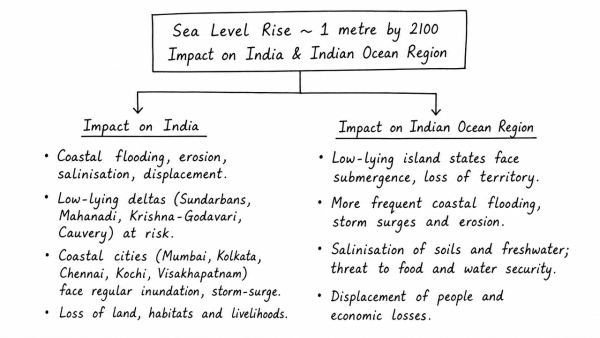
- Impact on India
- India’s long coastline and dense coastal settlements would face regular inundation, storm-surge flooding and loss of land.
- Low-lying deltas such as the Sundarbans, Mahanadi, Krishna-Godavari and Cauvery would be especially at risk of submergence and habitat loss.
- Major coastal cities like Mumbai, Kolkata, Chennai, Kochi and Visakhapatnam could suffer damage to ports, roads, railways, housing and power systems.
- Saltwater intrusion would damage fertile farmland, contaminate groundwater and reduce fish catch, affecting food security and livelihoods.
- Large-scale displacement may create internal climate migration, putting pressure on urban services and social stability.
- Impact on Indian Ocean region
- The Maldives faces an existential threat, as much of its land lies at very low elevation.
- Bangladesh would see severe coastal inundation, loss of cropland and massive displacement, with spillover effects on neighbouring countries.
- Island states such as Sri Lanka, Seychelles and Mauritius would face erosion of beaches, coral damage, tourism losses and freshwater stress.
- Sea-level rise may also disturb maritime boundaries, ports and coastal security in the region.
- Way forward
- Strengthen coastal embankments, mangroves, cyclone shelters and early-warning systems.
- Enforce climate-sensitive coastal planning under CRZ norms and prepare relocation plans for the most vulnerable areas.
Thus, a one-metre rise would not only be an environmental crisis but also a developmental, humanitarian and geopolitical challenge. India and Indian Ocean states must combine adaptation, ecosystem protection and risk-informed planning to reduce long-term losses.
Originally written on
September 4, 2026
and last modified on
September 4, 2026.