Explain how the Coral Bleaching Alert System (CBAS) assists in marine conservation. Why is biotechnology crucial for developing heat-tolerant coral reefs?
Coral reefs are among the most climate-sensitive ecosystems. The Coral Bleaching Alert System helps detect heat stress early, while biotechnology offers ways to strengthen coral survival under rising sea temperatures.
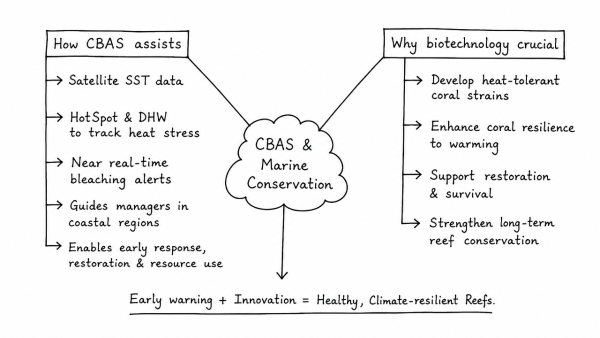
- CBAS and marine conservation: It uses satellite sea surface temperature data, HotSpot and Degree Heating Weeks to track thermal stress.
- It gives near real-time bleaching alerts, helping managers in the Andaman, Gulf of Kutch, Gulf of Mannar and Nicobar to plan monitoring and protection.
- Early warning supports rapid field response, restoration planning and better allocation of conservation resources.
- Why biotechnology matters: Natural coral adaptation is too slow for fast ocean warming.
- Assisted evolution, selective breeding, microbiome manipulation and gene editing can help identify or develop heat-tolerant corals.
- Cryopreservation also preserves coral genetic diversity for future restoration.
Together, CBAS and biotechnology improve preparedness now and build reef resilience for the future, but they must be used carefully with strong ecological safeguards.
Originally written on
September 12, 2026
and last modified on
September 12, 2026.