Critically discuss why enteric fermentation and paddy cultivation are primary methane sources in India, and how climate-smart agricultural practices can mitigate these emissions.
India’s methane emissions are dominated by agriculture because of its huge livestock base and extensive paddy area. Methane matters because it has a much stronger short-term warming effect than carbon dioxide, so cuts can quickly slow near-term warming.
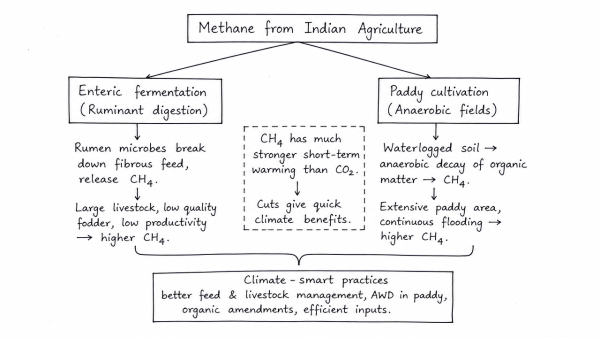
Enteric fermentation
India has the world’s largest livestock population and is a leading milk producer. Ruminants, especially cattle and buffalo, emit methane during digestion when rumen microbes break down fibrous feed. Emissions are higher in smallholder systems with low-quality fodder, low productivity, and large animal numbers, so methane per unit of milk remains high.
Paddy cultivation
India grows rice over vast flooded fields. Standing water creates anaerobic conditions that favour methane-producing microbes, and residue incorporation and some fertiliser practices add more decomposable organic matter. Because rice is central to food security, these emissions persist despite their intensity.
Mitigation
For livestock, better fodder, balanced rations, silage, chaff cutting, improved breeds, healthier animals, and manure-to-biogas systems can reduce methane per unit output. For rice, Alternate Wetting and Drying, Direct-Seeded Rice, and System of Rice Intensification reduce waterlogging and suppress methane; suitable crop diversification can further cut emissions and save water.
Thus, climate-smart agriculture can reduce methane while improving productivity, conserving water, and protecting farm incomes.