Nonlinear Editing
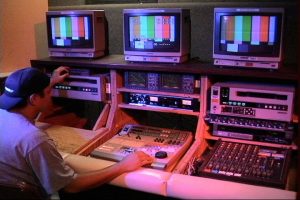
Nonlinear editing denotes a method of audio, video and image editing in which the original source material remains unaltered, and all editorial changes are achieved through instructions stored digitally rather than by modifying the media itself. This approach has become central to modern post-production workflows across broadcasting, filmmaking and multimedia content creation, replacing earlier, destructive or sequential analogue editing techniques.
Principles and Characteristics
Nonlinear editing is classified as a form of offline editing, meaning the system does not physically overwrite or modify the original recordings. Instead, a specialised software environment stores editorial choices using structures such as an edit decision list (EDL) for audio and video, or a directed acyclic graph for still images. When content is played back or rendered, the system reconstructs the final version in real time by applying the recorded edits to the untouched source files.
This arrangement allows highly flexible and nondestructive editing. Because changes modify only the digital instructions, not the underlying footage, editors can instantly rearrange, delete or refine cuts without damaging the material or causing quality degradation. The method contrasts with twentieth-century linear video editing, in which scenes were assembled in sequence and any change required overwriting sections, and with traditional film editing, where physical cutting of film constituted an irreversible and destructive process.
Nonlinear editing systems, whether video-based (NLE or NLVE) or audio-based (NLAE or DAW), provide a workspace in which edits, effects, transitions and layers can be manipulated freely, similarly to the cut, copy and paste functions of information technology or the dynamic revision processes of word processing.
Basic Techniques and Workflow
Nonlinear editing presupposes that media assets exist as digital files stored on servers, solid-state drives or hard disks. Editors can directly access any frame of video or segment of audio without scrubbing through adjacent material, enabling precise and efficient navigation.
Metadata is central to this process. On ingesting media, systems attach identifying information such as timecode, location, take numbers or descriptive tags, which may be generated automatically or entered manually. Editors can retrieve frames or clips instantaneously by reference to this metadata, allowing complex searches and rapid assembly of thematic or event-based selections—for example, isolating all clips associated with gold-medal winners during a sporting event.
Nonlinear workflows also allow editing at low resolution. Editors often work with proxy versions of high-definition or broadcast-quality footage, applying all decisions to the proxies while preserving the original high-resolution files. At the end of the process, the system can conform the final edit by applying the instructions to the master material, avoiding unnecessary re-encoding and reducing generation loss.
Broadcast Applications and Advantages
In broadcasting environments, audio and video data are typically captured to digital storage media and imported into servers where transcoding or digitisation occurs as required. Editors manipulate the footage using software tools, generating a frame-accurate EDL. This list can be transferred to an online suite, where the finished master is produced by assembling the high-quality source material according to the EDL’s instructions.
A key advantage of this method is the preservation of quality. Because the original files remain untouched and effects are applied non-destructively, the system avoids quality loss that arises from repeated copying or re-encoding. Although generation loss may still occur when lossy compression codecs are used, many widely adopted formats—such as Apple ProRes, AVC and MP3—balance file size reduction with high perceptual quality.
Nonlinear editing provides random access, extensive organisational control and the ability to create multiple versions of an edit without duplicating large media files. These attributes have made the approach suitable for both professional editing houses and domestic users, particularly as computing costs have declined and software options have expanded.
Methods of Accessing Material
Because media are digitally stored, systems employ several means of accessing content:
- Direct access: Editors work directly with media stored on a server using compatible codecs. The server functions as remote storage, and editing can occur without transcoding.
- Shared resource: Footage is transferred to shared storage accessible to multiple editors. Transcoding may be required if codecs differ.
- Importing: Media are downloaded locally for editing. This approach can coexist with the previous methods, offering flexibility in workflow design.
These methods support collaborative production environments and enable editing to begin even while transfers are incomplete, depending on system capability.
Leading Editing Software
For many years, Avid Media Composer has been the principal professional nonlinear editing platform, widely used in post-production facilities for feature films, television programmes, advertising and corporate communications. Reports from the early 2010s indicated its dominance in primetime television production.
Other influential software includes Adobe Premiere Pro, part of Adobe Creative Cloud; Final Cut Pro; DaVinci Resolve; and Lightworks. Cost models, subscription structures and the availability of mobile or free versions have encouraged rapid adoption among semi-professional and home users. DaVinci Resolve has grown particularly quickly, with millions of users employing its free version alone—figures comparable to those reported for Final Cut Pro X.
Consumers also benefit from built-in or freely downloadable tools, such as iMovie or various open-source editors including Blender and Cinelerra.
Home and Web-Based Use
Early domestic nonlinear editing relied on multimedia computers equipped with video capture cards for analogue video or FireWire connections for digital video. Once digitised, files could be edited and exported to recordable media or compressed formats such as MPEG for DVD creation.
Contemporary consumer workflows are increasingly web-based. High-quality footage can be uploaded directly from smartphones, and editing can be performed in browser-based interfaces without specialised hardware or installed software. The widespread use of social media has driven demand for accessible, powerful editing applications, extending nonlinear editing practices to a global user base.
Historical Development
Videotape editing in the 1950s required physical cutting and splicing, a labour-intensive method that risked continuity disruption. The introduction of the Ampex Editec system in 1963 enabled electronic editing through selective copying in a linear fashion, but the final product remained a copy of the original, leading to generation loss.
The first fully nonlinear editor, the CMX 600, was developed in 1971 by CMX Systems, a collaboration between CBS and Memorex. It represented a significant transition from mechanical and linear processes to instruction-based digital manipulation, laying the foundation for modern editing systems. Subsequent advances in storage, processing power and user interface design have further cemented nonlinear editing as the standard method for audiovisual production.
| Related | |
|---|---|