Land Mines in Cambodia
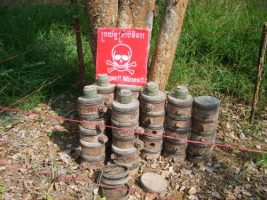
Cambodia is a country in Southeast Asia that continues to face one of the most severe landmine and unexploded ordnance (UXO) crises in the world. This situation is the direct legacy of nearly three decades of armed conflict, including the Cambodian Civil War, the Khmer Rouge regime, regional border conflicts, and the Vietnamese occupation. The extensive deployment of anti-personnel mines across rural and border areas has caused long-lasting humanitarian, social, economic, and environmental consequences for the Cambodian population.
Despite significant progress in mine clearance since the early 1990s, landmines remain a persistent threat, particularly in agricultural regions, where livelihoods depend heavily on access to land.
Historical background and origins of contamination
The large-scale contamination of Cambodia with landmines occurred primarily during the 1970s and 1980s, a period marked by intense conflict among multiple factions. These included the Lon Nol government, the Khmer Rouge, the Heng Samrin regime, the Hun Sen government, and the Coalition Government of Democratic Kampuchea, which retained Cambodia’s United Nations seat throughout much of the 1980s with international backing.
Landmines were laid extensively across the country by all sides, often without proper documentation or mapping. As a result, many of those who placed the mines later had no records or memory of their locations, greatly complicating post-war clearance efforts. Mines were deployed both offensively and defensively, including to protect military positions, borders, supply routes, and even religious and cultural sites.
A particularly tragic episode occurred during the Dangrek region violence in June 1979, where large numbers of civilian casualties resulted from people unknowingly crossing minefields laid along border areas by Thai, Vietnamese, and Khmer Rouge forces. These mines were not confined to specific front lines but were scattered across villages, farmland, forests, and pathways throughout Cambodia.
Scale of the landmine problem
The scale of landmine contamination in Cambodia is among the highest globally. The Cambodian Mine Action Centre (CMAC) has estimated that there may be between four and six million landmines and other unexploded ordnance remaining in the country, while some estimates suggest the figure could be as high as ten million.
This extensive contamination has resulted in approximately 40,000 amputees, giving Cambodia one of the highest per capita rates of landmine amputations in the world. The impact has been especially severe in rural provinces, where communities rely on farming, forestry, and water access, all of which are frequently restricted by the presence or perceived presence of mines.
Casualty patterns and demographic impact
Cambodia has consistently recorded high landmine casualty rates. Data from the Cambodian Mine Victim Information Service (CMVIS) indicate that Cambodia has ranked among the countries with the highest number of mine casualties worldwide.
In 2013, there were 111 casualties, including 22 fatalities and 89 injuries. Approximately one-third of all casualties were children, with boys disproportionately affected. Research indicates that boys and men are more likely than women to handle or investigate unfamiliar objects, increasing their risk of injury.
Among surviving victims, 87 per cent are males over the age of 15, with a mean age of around 28 years, reflecting the heavy toll on the working-age population. Medical access remains a major challenge; international humanitarian data show that only 25 per cent of victims reach hospital care within six hours, while 15 per cent take more than three days to access medical treatment, significantly increasing the risk of death or permanent disability.
In the first half of 2016, landmine-related deaths nearly doubled compared with the same period in the previous year, highlighting the continuing danger posed by remaining mines despite declining injury numbers overall.
Social consequences
The social consequences of landmines in Cambodia are profound and long-lasting. Victims are often the primary income earners within their families, and the loss of a limb or severe injury places enormous strain on household finances, education opportunities, and long-term wellbeing.
Families with limited income and poor access to healthcare face heightened vulnerability. In many cases, the absence of comprehensive government assistance or rehabilitation services exacerbates poverty and social exclusion. The burden extends beyond individual victims, affecting entire communities and contributing to intergenerational disadvantage.
Landmines also influence behaviour at the community level. Fear of contamination discourages farming, gathering firewood, grazing livestock, and accessing water sources. This behavioural adaptation contributes to food insecurity, reduced agricultural productivity, and, in some cases, malnutrition, particularly in already impoverished rural regions.
Socioeconomic effects
The broader socioeconomic impact of landmines in Cambodia has been documented through national surveys. The National Level One Survey (2002) found that 2,776 out of 13,908 villages, or roughly 20 per cent, were contaminated by landmines and/or cluster munitions. These contaminated areas were associated with significant adverse effects on livelihoods and development.
Reported impacts included restricted access to:
- Agricultural land, affecting over 102,000 families
- Pasture land, affecting more than 105,000 families
- Forest resources, affecting over 172,000 families
- Water sources, affecting nearly 85,000 families
The Cambodia Socio-Economic Survey (2004) further revealed that households headed by individuals with disabilities had significantly lower wealth levels than other households. Where disabilities were caused by war or landmines, poverty rates were nearly three times higher than in cases where disabilities resulted from other causes. This demonstrates the deep and lasting economic consequences of conflict-related injuries.
Demining efforts and institutions
Cambodia has developed one of the most extensive mine action programmes in the world. There are currently seven major demining organisations operating in the country. Central among these is the Cambodian Mine Action Centre (CMAC), established in 1992 by the Supreme National Council of Cambodia.
The Cambodian Mine Action Authority (CMAA) was created in 2000 as the national regulatory body responsible for coordinating demining activities, establishing policies, and overseeing victim assistance. Other key actors include the Royal Cambodian Armed Forces, The HALO Trust, and the Mines Advisory Group (MAG).
Identifying mine locations remains extremely challenging due to the absence of reliable records. Mine detection requires specialised equipment, trained personnel, and significant financial investment. Most remaining mines are concentrated in the north-western provinces, particularly along former conflict zones near the Thai border.
Use of animals in mine detection
Innovative detection methods have been adopted to support clearance efforts. With technical and financial assistance from the Norwegian People’s Aid, CMAC deployed landmine detection dogs in the early 2000s. While effective, these dogs face health risks from parasites such as fleas, ticks, and mosquitoes, leading to early retirement or death.
Since 2014, the Belgian non-governmental organisation APOPO has introduced African giant pouched rats into Cambodia’s demining programme. These rats are trained to detect explosives by scent and are lighter than humans, allowing them to traverse minefields safely. Since 2016, APOPO’s rats have identified approximately 500 anti-personnel mines and over 350 items of unexploded ordnance, significantly contributing to clearance efficiency.
Financial costs and future outlook
In 2003, the CMAA estimated that Cambodia’s annual demining costs, including technical assistance and in-kind contributions, amounted to around US$40 million. Experts have projected that, if funding levels are maintained, Cambodia would require an additional 10 to 20 years to fully clear remaining mines.
While international support has been crucial, sustaining long-term funding and addressing victim rehabilitation remain ongoing challenges. Mine clearance alone is insufficient without parallel investment in healthcare, prosthetics, vocational training, and social reintegration.