ICT Applications in Governance, Education and Health
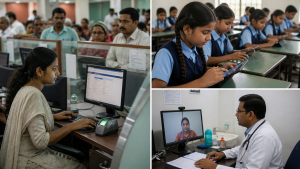
Information and Communication Technology (ICT) has become a key driver of governance reform, modern education delivery, and healthcare access in India. By replacing paper-heavy processes with digital platforms, ICT improves transparency, speed, reach, and record-keeping across public services.
ICT in Governance and Public Administration
Digital governance uses population-scale infrastructure to deliver public services more transparently and reduce bureaucratic delays. It also helps plug welfare leakages by enabling direct authentication, online service access, and digital record management.
- Aadhaar: A biometric-based unique identity framework that enables remote electronic authentication for residents.
- UMANG: A unified mobile application that integrates hundreds of central and state government services in one interface.
- DigiLocker: A cloud-based digital document repository that gives legal validity to electronic certificates and identity records.
- Common Service Centres (CSCs): Local digital access points, especially in rural areas, offering banking, e-governance, and utility payment services.
Administrative Workflows and Welfare Delivery
- PRAGATI: Uses satellite imagery and database tools to monitor delayed infrastructure projects and address public grievances at the highest executive level.
- e-Office: Replaces physical file movement inside government secretariats with digital workflows, improving accountability and reducing paper use.
- Direct Benefit Transfer (DBT): Transfers welfare subsidies directly to beneficiaries’ bank accounts through the JAM Trinity, reducing intermediaries.
- JAM Trinity: The linkage of Jan Dhan accounts, Aadhaar, and mobile numbers used to support direct subsidy delivery.
ICT Applications in Education
Technology in education expands access to digital content, supports teacher training, and helps bridge rural-urban learning gaps. It also makes learning more flexible through online, broadcast, and mobile-based formats.
- DIKSHA: The national digital infrastructure for teachers and students, offering open-access e-textbooks and training modules in multiple regional languages.
- SWAYAM: A platform for massive open online courses across secondary, higher education, and vocational streams, with credit-linked learning options.
- PM e-VIDYA: Brings together television channels, radio broadcasts, and digital portals to provide multi-modal access to school education.
- Unified District Information System for Education Plus (UDISE+): Digitizes school data collection and tracks infrastructure, enrollment, and teacher deployment.
- National Academic Depository: Stores digital academic awards and enables verified electronic access to degrees and mark sheets.
ICT Applications in Healthcare
Digital health tools decentralize medical access, streamline hospital workflows, and support unified patient records across facilities. They are especially useful for reaching remote areas and reducing physical congestion in hospitals.
- eSanjeevani: The national telemedicine service enabling doctor-to-doctor and patient-to-doctor consultations.
- Digital diagnostic kiosks and mobile health units: Link remote community health centres with specialist hospitals through broadband connectivity.
- Ayushman Bharat Digital Mission: Creates unique Ayushman Bharat Health Account (ABHA) IDs to connect verified medical records across clinics and laboratories.
- Online Registration System: Allows patients to book hospital appointments digitally and reduces queueing in outpatient departments.
- Co-WIN and e-Hospital: Manage immunization tracking, digital certificate generation, and bed availability monitoring.
Supporting Digital Infrastructure
- National Informatics Centre (NIC): Established in 1976 to support e-governance applications and district-level network connectivity.
- BharatNet: The world’s largest rural optical fibre connectivity programme, designed to connect all gram panchayats with high-speed broadband.
- Open Network for Digital Commerce (ONDC): Creates interoperable open protocols for buyer-seller transactions and democratizes digital retail.
- National Data Centre facilities: Provide secure cloud hosting under the MeghRaj initiative for departmental e-governance workloads.
Comparative Snapshot
| Sector | Primary Platform / Initiative | Core Function | Nodal Implementing Agency |
| Governance | UMANG | Unified delivery of central and state e-services | Ministry of Electronics and Information Technology |
| Education | DIKSHA | Digital textbooks and teacher professional development | Ministry of Education |
| Healthcare | eSanjeevani | National teleconsultation service for remote areas | Ministry of Health and Family Welfare |
| Infrastructure | DigiLocker | Cloud-based secure storage of official documents | Ministry of Electronics and Information Technology |
Key Prelims Takeaways
- Aadhaar supports biometric identification and remote authentication in service delivery.
- UMANG is a single mobile interface for multiple government services.
- DigiLocker gives legal validity to digital documents and certificates.
- DBT uses the JAM framework to transfer subsidies directly into bank accounts.
- DIKSHA is the national digital platform for teachers and students.
- eSanjeevani is India’s national telemedicine service.
- BharatNet is aimed at broadband connectivity for gram panchayats.
| Related | |
|---|---|