Key National Missions and Schemes Promoting Digital Infrastructure
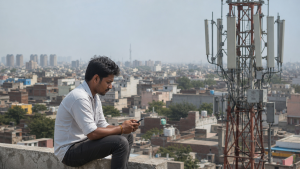
India’s digital infrastructure rests on a mix of national missions, broadband expansion projects, telecom reforms and public digital platforms. Together, these measures aim to expand last-mile connectivity, strengthen local telecom manufacturing, and simplify regulation for the fast-growing digital economy.
Evolution of Digital India and NBM 2.0
- Digital India Programme: It completed 11 years of implementation on July 1, 2026, after being launched on July 1, 2015. The digital economy is currently estimated to contribute between 12% and 14% of national GDP.
- UPI as public digital infrastructure: The Unified Payments Interface handles about 49% of the global real-time digital transaction volume, making it a major pillar of India’s digital public infrastructure.
- National Broadband Mission (NBM) 2.0: Launched on January 17, 2025 and effective from April 1, 2025, it succeeded NBM 1.0 (2019–2024) with a sharper focus on high-speed internet access.
- 2030 targets under NBM 2.0: The mission aims to extend optical fiber cable (OFC) connectivity to 2.70 lakh villages, achieve a minimum fixed broadband download speed of 100 Mbps nationwide, and provide broadband access to 90% of anchor institutions.
- Broadband performance: The national average fixed broadband download speed reached 60.85 Mbps as of March 31, 2026.
- Right of Way (RoW) reform: The average processing time for RoW applications declined to 35.62 days in 2025–26 from 80.63 days in 2024–25.
Amended BharatNet Program and Digital Bharat Nidhi
- Amended BharatNet Program (ABP): Approved in August 2023, it targets OFC connectivity to 2.65 lakh Gram Panchayats (GPs) and 3.8 lakh non-GP villages on demand.
- Progress under ABP: As of June 2026, 43,908 km of optical fiber cable had been laid and 13,494 Gram Panchayats had been upgraded.
- Digital Bharat Nidhi (DBN): BharatNet is now funded through DBN, which replaced the Universal Service Obligation Fund (USOF) under the Telecommunications Act, 2023.
- BharatNet Phase 3: In March 2026, BSNL signed an ₹8,025 crore contract with Pratap Technocrats to deploy infrastructure across Rajasthan, Haryana and Assam.
PM-WANI and Telecom Manufacturing Growth
- PM-WANI framework: It allows small shopkeepers and other local operators, called Public Data Offices (PDOs), to provide public Wi-Fi hotspots without licensing, registration or fee payments.
- Key PM-WANI entities: The framework includes PDOs, PDO Aggregators (PDOAs), App Providers and a Central Registry maintained by the Centre for Development of Telematics (C-DoT).
- PM-WANI rollout: By 2026, the Central Registry recorded 418,806 deployed Wi-Fi hotspots, 206 active PDO Aggregators and 112 active App Providers.
- Data usage: Cumulative internet data usage under PM-WANI crossed 58 petabytes.
- PLI Scheme for Telecom and Networking Products: As of September 30, 2025, the scheme recorded cumulative investments of over ₹4,646 crore and total sales exceeding ₹96,240 crore, including exports worth ₹19,240 crore.
- 4G Saturation Project: Under the ₹30,620 crore project and other DBN-funded mobile schemes, 24,784 mobile towers had been commissioned across India as of June 30, 2026.
New Legislative and Regulatory Framework
- Telecommunications Act, 2023: It replaced the Indian Telegraph Act, 1885; the Indian Wireless Telegraphy Act, 1933; and the Telegraph Wires (Unlawful Possession) Act, 1950.
- Unified authorisation: The Act introduced a unified authorisation framework for telecom services and provides for a maximum authorisation period of 20 years.
- 2026 authorisation rules: The Department of Telecommunications notified the Telecommunications (Authorisation for Provision of Principal Telecommunication Services) Rules, 2026, replacing the legacy Unified Licence (UL) and UL-VNO licensing frameworks.
- Other 2026 rules: These included the Captive Telecommunication Services Rules, the Provision of Miscellaneous Telecommunication Services Rules, the User Identification Rules and the Radio Equipment Possession Authorisation Rules.
- Broadcasting reform: The Ministry of Information and Broadcasting released the draft Telecommunications (Television, Radio and Associated Services) Rules, 2026 in June 2026 to simplify and unify broadcasting guidelines.
Key Prelims Takeaways
- Digital India: Launched on July 1, 2015; completed 11 years on July 1, 2026.
- NBM 2.0: Effective from April 1, 2025; aims to strengthen high-speed broadband and OFC reach by 2030.
- BharatNet funding: Managed through Digital Bharat Nidhi (DBN), which replaced USOF under the Telecommunications Act, 2023.
- PM-WANI: A decentralized public Wi-Fi model based on PDOs, PDOAs, App Providers and a central registry.
- Telecom reform: The Telecommunications Act, 2023 replaced three colonial-era telecom laws and created a unified authorisation regime.
- Manufacturing push: The PLI Scheme for Telecom and Networking Products is supporting domestic investment, sales and exports.
- Connectivity targets: Important figures include 2.70 lakh villages under NBM 2.0, 2.65 lakh GPs under ABP, and 24,784 commissioned towers under the 4G Saturation Project.
Current General Studies comprises current-affairs-based, General Studies-rich study material on policies, laws, institutions, economy, science, environment, governance, international relations, and other varied but important topics for UPSC and State PSC Prelims examinations.
Fortnightly PDF compilations: Available here
Originally written on
April 18, 2026
and last modified on
September 5, 2026.
| Related | |
|---|---|