Admiralty Islands
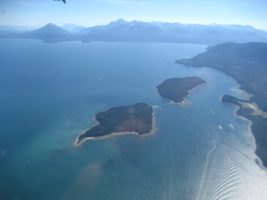
The Admiralty Islands are a group of around forty islands forming part of the Bismarck Archipelago, situated to the north of New Guinea in the western Pacific Ocean. Often referred to collectively as the Manus Islands after their largest island, this rainforest-covered archipelago constitutes Manus Province, the least populous province of Papua New Guinea. Although remote, the islands occupy an important place in the cultural, ecological and historical landscape of the region.
Geography
The Admiralty Islands include both large volcanic islands and smaller atolls, many of which remain uninhabited. Manus Island is the largest, followed by Los Negros Island, which is linked to Manus by a road extending from the provincial capital Lorengau. Other significant islands in the group include Tong, Pak, Rambutyo, Lou, Baluan, Mbuke and Bipi. Smaller offshore islands such as Ndrova, Pityilu and Ponam have played notable roles in the historical development of Manus society.
The climate varies little throughout the year, featuring consistently warm temperatures, high humidity and substantial rainfall. Annual precipitation is heavy, with a pronounced wet season between June and August. Manus Island reaches a volcanic elevation that likely emerged above the ocean surface during the late Miocene, approximately eight to ten million years ago. Its geology consists of volcanic materials and uplifted coral limestone. Sea transport remains the primary means of movement between islands, and tourism is minimal despite the attraction the region holds for divers.
Ecology
Owing to their isolation, the Admiralty Islands support a distinctive suite of flora and fauna and are recognised as a separate ecoregion: the Admiralty Islands lowland rain forests. Forest cover remains extensive on Manus, though various smaller islands have been cleared for coconut cultivation. Trees of the genera Calophyllum and Sararanga are typical of the region’s forests.
Two protected areas highlight the ecological importance of the islands:
- the Ndrolowa Wildlife Management Area, established in 1985 south of Lorengau, encompassing both terrestrial and marine environments;
- a protected zone surrounding Mount Dremsel, the island’s highest peak, although the extent of its formal protection status remains uncertain.
Several endemic species are central to conservation efforts. Birds listed as vulnerable on the IUCN Red List include the Manus fantail (Rhipidura semirubra), superb pitta (Pitta superba) and Manus masked owl (Tyto manusi). The Manus dwarf kingfisher (Ceyx dispar) is considered near threatened. Other endemic birds regarded as of least concern include the white-naped friarbird (Philemon albitorques), Manus monarch (Monarcha infelix) and Manus hawk owl (Ninox meeki). Additional species largely associated with the Admiralty region include the Melanesian megapode, yellow-bibbed fruit-dove, yellowish imperial pigeon, pied cuckoo-dove, Meek’s pygmy parrot, black-headed white-eye and ebony myzomela.
Mammalian diversity is notable for several endemic fruit bats and marsupials. These include the Admiralty flying fox (Pteropus admiralitatum), Andersen’s naked-backed fruit bat (Dobsonia anderseni), Seri’s sheathtail bat (Emballonura serii), the Admiralty Island cuscus (Spilocuscus kraemeri) and a local species of Melomys. Amphibians and reptiles add further uniqueness, with two endemic frogs (Cornufer admiraltiensis and Cornufer latro) and several lizards. The emerald green snail of Manus is particularly significant as the first terrestrial snail to be classified as vulnerable by the IUCN.
Prehistory
Archaeological and anthropological evidence indicates human presence in the Admiralty Islands for approximately 40,000 years, paralleling early settlement patterns in New Guinea, the Bismarck Archipelago and the Solomon Islands. Early inhabitants cultivated taro and introduced domesticable species such as bandicoots and large rats from New Guinea. Obsidian from the islands was widely traded, establishing long-distance regional networks.
Around 3,500 years ago, the Lapita cultural complex emerged, extending from the Admiralty Islands eastward to Tonga and Samoa. Known for its decorated pottery, stilt houses, domesticated pigs, dogs and chickens, and advanced seafaring technologies, Lapita society facilitated broad inter-island exchange. Its influence declined around 2,000 years ago, marking the fragmentation of its extensive trade networks.
European and Japanese Periods
European contact began in 1528 when the Spanish navigator Álvaro de Saavedra Cerón encountered Manus while attempting to sail from Tidore to New Spain. Later visits by Dutch explorers, including Willem Schouten in 1616, expanded European knowledge of the archipelago. In 1767, Captain Philip Carteret of the Royal Navy named them the “Admiralty Islands”.
Between 1884 and 1914, the islands were administered as part of German New Guinea. Early in World War I, they were seized by Australian forces with minimal resistance. Australia continued to govern the region under a League of Nations mandate following the war.
The archipelago was occupied by Japanese forces in April 1942 during World War II. In 1944, Allied forces launched the Admiralty Islands campaign, successfully capturing the islands and establishing a major United States airbase and naval installation at Lombrum.
| Related | |
|---|---|