Winterberg
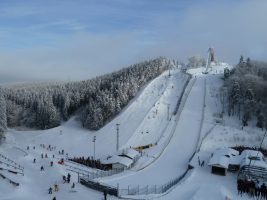
Winterberg, known in the Westphalian language as Winnenmerg, is a town situated in the Hochsauerland district of North Rhine-Westphalia in central Germany. It is widely recognised as one of the most important winter sports resorts in the Sauerland region, particularly for the Skiliftkarussell Winterberg, one of Germany’s largest interconnected ski areas. Owing to its altitude, climate, and geographical setting, Winterberg has developed a distinctive historical, economic, and cultural identity shaped by trade, seasonal agriculture, and modern tourism.
Geographical Setting
Winterberg lies in the heart of the Sauerland, a low mountain range in western Germany, and occupies a strategically significant position at the sources of two major rivers: the Ruhr and the Lenne. This elevated watershed location has historically influenced settlement patterns, climate, and land use. The town is surrounded by forested uplands and rolling hills that form part of the Rothaargebirge, contributing to its appeal as a recreational and climatic health resort.
Following the municipal reforms of 1975, Winterberg was administratively reorganised and now comprises 15 districts: Altastenberg, Altenfeld, Elkeringhausen, Grönebach, Hildfeld, Hoheleye, Langewiese, Lenneplätze, Mollseifen, Neuastenberg, Niedersfeld, Siedlinghausen, Silbach, Winterberg, and Züschen. These districts reflect the historical incorporation of surrounding villages and hamlets into a single municipal structure.
Climate
Winterberg experiences a humid continental climate under the Köppen climate classification (Dfb), which is typical for much of Germany. However, due to its relatively high altitude, the climate also borders on subarctic conditions (Dfc). Average monthly temperatures exceed 10 °C only briefly during the summer, with September barely meeting this threshold. Summers are short and cool, while winters are cold, though generally milder than those in the Alps or the Ore Mountains.
The growing season in Winterberg is notably short, lasting approximately 100 days. Depending on interpretative criteria, the climate may alternatively be described as a temperate oceanic climate (Cfb) bordering on a subpolar oceanic climate (Cfc). These climatic characteristics have historically limited agricultural productivity while favouring forestry and, in modern times, winter sports tourism.
Origins and Medieval Development
Winterberg was formally granted town status by Konrad von Hochstaden, Archbishop of Cologne, around 1270. The foundation of the town is closely associated with the establishment of a nearby cloister in Küstelberg, indicating ecclesiastical influence on early settlement. A document from 1276 outlines the legal rights and obligations between the archbishop and the cloister and references a church in Winterberg whose origins likely date back to around 1225.
Initial fortifications were established in the 14th century but offered only limited defensive capability. In 1321, the town was conquered by the Count of Waldeck, and around 1357 it was largely destroyed during conflicts between Gottfried IV of Arnsberg and Archbishop Wilhelm von Gennep. To encourage reconstruction, the archbishop granted Winterberg extended periods of tax exemption, beginning with ten years and later prolonged in stages.
During this period, Winterberg possessed town rights equivalent to those of Hallenberg and emerged as a regional centre of trade.
Role in Trade and the Hanseatic League
From the 13th to the 17th century, Winterberg was a member of the Hanseatic League, reflecting its economic integration into long-distance trade networks. The town lay at the intersection of two important medieval trade routes: the Heidenstraße, connecting Cologne and Kassel, and the Heerstraße, linking Frankfurt am Main with Soest.
Poor agricultural conditions meant that commerce, craftsmanship, and trade became central to the town’s economic survival. Market activities and transport services sustained Winterberg during periods when subsistence farming alone would have been insufficient.
Deserted Settlements in the Late Middle Ages
Between approximately 1350 and 1500, numerous surrounding settlements, including Wernsdorf, Merleheim, Haarfeld, Gönninghausen, and Elkeringhausen, were abandoned. Their inhabitants often relocated to Winterberg while retaining legal rights to their former lands. This process is generally attributed to the Black Death, recurring feuds, and widespread insecurity, as fortified towns provided better protection against armed conflict and looting.
At this time, only a few towns in the region, notably Winterberg, Hallenberg, Schmallenberg, and Medebach, remained continuously inhabited, while much of the surrounding countryside was likely depopulated.
Early Modern Period and the Thirty Years’ War
Between 1500 and 1650, Winterberg expanded its territorial holdings, particularly following the acquisition of the region known as Marken. Similar expansion occurred in neighbouring towns, often leading to boundary disputes. In the early 16th century, Winterberg extended its farmland towards Altenberg, resulting in prolonged conflicts with the Counts of Waldeck and later with the County of Wittgenstein. These disputes persisted until a territorial compromise was reached in 1783.
During the Thirty Years’ War, neighbouring towns such as Medebach and Hallenberg were devastated in 1634 by Hessian troops and subsequently ravaged by plague. Winterberg appears to have suffered comparatively less destruction. Evidence of relative stability includes the town council’s purchase of a new church organ in 1638–1639 for 240 imperial talers. An attempted siege around 1640 was reportedly repelled by local marksmen, defending the town against Hessian and Swedish forces.
Witch Hunts
As in many parts of the Duchy of Westphalia, Winterberg experienced witch hunts between the 16th and 18th centuries. Due to limited surviving records, the precise number of victims remains unknown. Documented witch trials occurred in 1523, probably in 1562 and 1629, and possibly as late as 1728. On 19 November 1993, a memorial was unveiled at the site of the former Halsgericht to commemorate the victims of these persecutions.
Natural Features and Points of Interest
Within Winterberg’s municipal boundaries lies the Kahler Asten, the second-highest mountain in the Sauerland, situated in the Rothaargebirge. The area is also notable as the source region for both the Ruhr and the Lenne rivers, underlining its hydrological significance for western Germany.
Sport and Tourism
Winterberg is one of the most prominent winter sports centres in the Sauerland. It is internationally known for its bobsleigh, luge, and skeleton track, which hosts major competitions. In 2003, Winterberg gained wider popular recognition through the inaugural World Wok Racing Championships, initiated by German entertainer Stefan Raab.
Beyond winter sports, the town also attracts visitors for hiking, cycling, and nature tourism, making it a year-round destination.
Coat of Arms
The coat of arms of Winterberg depicts the town with its historic city walls, which existed only briefly between 1261 and 1266. Behind the walls stands Saint James the Greater, son of Zebedee and patron saint of the town. Winterberg’s location along one of the routes of the Way of St James explains this association and highlights its historical role in pilgrimage networks.